Pages

Monday, March 12, 2012

For better or for worse?


It used to be that when exciting things happened in people’s lives or if people wanted to talk with their friends, they would walk or drive over to their house, sit down and have a conversation. The next best thing to actually spending time with this person was calling them, maybe texting them. The cell phone used to be one of the only mediated types of communication. Then email became popular, and then Facebook and Twitter emerged. Everything about interpersonal relationships has changed due to the social media phenomenon. It may seem like a long time ago that social media took over, but actually it wasn’t. Facebook didn’t go live to the public until September of 2006. This means that in the span of 6 short years, the way we handle relationships has changed. The question to ask is, has it changed for the better making relationships as meaningful as old face-to-face interaction?
As with any type of question there are two sides and opinions to answering this question. I can see the reasoning in both sides and am going to explore both.  
In terms of relationships between families, old friends, new acquaintances, and people who don’t live near each other, social media and interacting online can be very helpful. According to Jeff Hancock, PhD, director of graduate studies in the Department of Communications at Cornell University, “Allowing people to stay in touch in so many ways can strengthen our ability to have close relationships,” he says. Family and friends who get to video chat with their loved ones through the video chat application on Facebook and other programs, are appreciative that they can stay in touch without physically being in each others lives. It is nice to be able to stay in touch with old high school friends or it can be a nice way to contact someone that you haven’t heard from in a long time. Social media can also connect people on professional levels like through sites such as LinkedIn. This can be a helpful tool to find internships and job opportunities. If social media is used in the right way and doesn’t become something that people obsess about and base their life around, it can be a very unique tool that helps people stay connected throughout their lives.
            When it comes to romantic relationships social media can be more of a negative tool than a positive one. It opens up the opportunity for spying, stalking, jealousy, and assumptions, which ultimately ends in fights. According to experts “Facebook has caused “Digital intimacy,” in which studies have shown that 3/5 men and 4/5 women sleep together sooner than they normally would.” People are starting to confuse digital intimacy with true intimacy. The relationship status on Facebook has changed the definition of what a relationship is. Dating is becoming so publicized that the idea of true honest relationships is loosing value because the instant someone becomes “in a relationship” on Facebook, there are people who “like” it immediately which gives attention to the couple instantly. If there is attention when people start dating, then the attention when a relationship ends is even bigger. Then you deal with the people who stalk their ex’s pictures and get upset because it looks like they are hanging out and/or dating someone else that they know. The idea that we can know so much about someone’s life through one little page on a website changes everything. There is no more calling and asking how things are going, because more than likely people know what is going on in their friends lives through stalking them on Facebook or Twitter. The urge to reach out to friends or people you haven’t talked to in a while is less pressing. 
            I think the only solution to the social media phenomenon is to use it wisely and find the happy medium. Don’t always rely on Facebook or Twitter to catch up with old friends. Make it a goal to talk to call someone who you usually would talk to through text or social media. 

Sunday, March 11, 2012

Social Games

This past week saw the release of another iteration of the popular video game series called Mass Effect. I am a huge fan of the series, and one of the biggest changes made in this newest game is one that has happened across the gaming industry itself, which is the role of playing with others and being social. This series like many others of the past used to be geared specifically for an individual experience. However, with this newest game the developers finally decided to put in the option of playing with others. Most of the best-selling games today usually attempt to provide an experience that can be played alone and with others, and this has changed how many people view video games.

Playing a video game alone is definitely not for everyone. Sometimes I love playing games with my friends, and sometimes I just want to play a game by myself. Still, the fact that people have been provided with more choices as to how they want to play has helped video games find an even larger audience. It has become a type of social activity for many, and it's one that's here to stay. If you play games, do you prefer to play alone or with people? 

May the odds be ever in your favor...

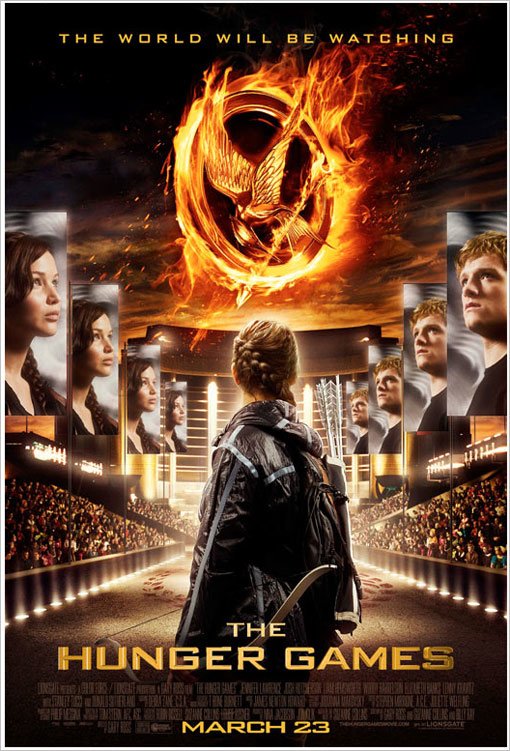
Welcome, welcome! If you've been plugged into entertainment media at all for the past few months, you've probably heard something about a little production called The Hunger Games. Personally, I have been looking forward to this movie ever since I devoured the book a year and a half ago, and now that its release date (March 23rd) is fast approaching, I thought I'd share my excitement with my fellow citizens of the blogosphere.

For those of you who don't know, or just never looked into it, The Hunger Games is a new movie adapted from the best selling novel by Suzanne Collins set to release March 23rd, which many people, fans and press alike, are promoting as the next Harry Potter or Twilight. The movie, which is described in more detail on its IMDB page, is set in a future North America, now called Panem, whose government requires two children from each its twelve districts to enter an arena and fight in a nationally televised death match. It's pretty intense. But so incredibly awesome.

Anyway, huge media properties such as this, and Harry Potter and Twilight before it, have always fascinated me. The way that a single story or movie can capture such a huge and diverse audience and bring them together is pretty damn cool. In my personal experiences in various fandoms, movie adaptations which cater to the fans of the books tend to be the most successful, not to mentioned the most beloved. And The Hunger Games is certainly adhering to this model, with a huge internet presence that goes beyond a simple "official movie site" and plastering ads everywhere in sight. There's some really cool stuff out there, and the extra effort made for fan involvement only makes me that much more excited.

Cool Stuff!
The Capitol (this is my favorite): http://thecapitol.pn/
The official movie page:http://tinyurl.com/6rhawac
On Facebook: http://tinyurl.com/3at8pzt
The Hob: http://www.thehob.org/
Mockingjay: http://mockingjay.net/
Hunger Games Merch: http://tinyurl.com/7lgojm5

So readers, are you excited for The Hunger Games? Do you love or hate media events like this? And, of course, are you Team Peeta or Team Gale? (Team Peeta ftw!)

~Morgen~


Call Me(dia) Maybe


 Last week I was hanging out with friends looking at YouTube videos. Sitting around watching YouTubes has become a common activity amongst our generation. One of my friends excitedly asked if we had seen this music video titled "Call Me Maybe" by Carly Rae Jepsen - Feat. Justin Bieber, Selena, Ashley Tisdale & MORE! The video captures  Justin Bieber, Selena Gomez, and Ashley Tisdale  hanging out with their friends, dancing and lip syncing to the song titled "Call Me Maybe" by Carly Rae Jepsen. When not appearing on the red carpets, these pops stars like to have fun with their friends and do stuff that regular kids like to do, such as make YouTubes. YouTube has become one of the most utilized platforms for self-broadcasting and perhaps finding the next big star. After all, YouTube is the cause for spreading the "Bieber Fever" epidemic. The song "Call Me Maybe"  has become instantly popular, even playing at a couple parties that I have recently attended. This video was only updated 3 weeks ago and has  over 20,367,704 views.

Prior to watching the YouTube, I was unaware of the artist and never heard of her song.  The popularity of this YouTube had me thinking about today's digital social media and how one post or upload of some sort  can instantly change someone's life.  Since I was unfamiliar with Carly Rae Jepsen, I decided to look into her music career background. When I typed Carly Rae Jepsen into Google, to not much surprise, there was a Wikipedia article on her. According to Wikipedia, Carly is a Canadian artist who was a contestant on the 5th season of Canadian Idol in 2007. Apparently Carly has been in the industry for quite some time now. Her second album was released only last month in February, which features the single "Call Me Maybe." As I further read the Wiki article, interestingly enough, Carly is signed with the same manager as Justin Bieber (Scooter Braun). Taking all these factors into consideration, I cannot help but make the assumption that the "Call Me Maybe" YouTube was a simple market tactic to help publicize Carly Rae Jepsen's single and to gain name recognition. In my opinion, it was a brilliant PR move.

Lets break this logic down: Justin Beiber and Selena Goemz are one of the most famous and idolized pop stars of this time. Specifically, towards the young tween female demographic.  Justin and  Selena have massive fan followings and the fan loyalty is quite over whelming. Since Carly Rae  Jepsen is an upcoming, young pop star, why not take advantage of Justin and Selena's fan loyalty!? Of course their die heart fans are going to watch a video of their favorite stars singing  and without a doubt, they are going to share the video with all their friends who are just as obsessed as they are. Not only are the fans going to watch the video, but they are going to download and search for the song "Call Me Maybe." There you have it:  Carly Rae Jepsen is now rising to stardom and social media is a huge thanks to it. Ten years ago, most stars would rise to fame by airing on MTV or in entertainment magazines. Better yet, the radio would be one of the first mediums to promote a new artist and hit single. With all the social media mediums, it seems that TV and the radio is not the most effective way to promote music or up coming stars such as Carly Rae Jepsen. So what I am I trying to get at is how much influence does the new media have over the old media? With the song becoming popular through YouTube, do mediums such as the radio or TV rely on the digital social media mediums for content?  I can only imagine in a matter of time, "Call Me Maybe" will be blasting in car radios and the YouTube will be talked about on some entertainment show. What are your thoughts on old media relying on new media and what do you think of the YouTube being a marketing tactic in general!?

The YouTube for your pleasure : http://www.youtube.com/watch?v=AsBsBU3vn6M
Wikipedia Article: http://en.wikipedia.org/wiki/Carly_Rae_Jepsen

Monday, March 5, 2012

Facebook VS. Twitter: Contradictions?


           When I came across the demographics from 2010 about the usage of Twitter and Facebook, I got to thinking about what each of their purposes are and if they are in competition. Are there contradictions between the two? What about the contradictions between interpersonal communication and the communication that is going on within Facebook and Twitter.
            Last week I attended a presentation given by a representative from Twitter, and he touched on the topic of whether or not they are in competition with Facebook. He explained that there really is no competition because Twitter is interest based and Facebook is more based on your social circle and who you are friends with. He made a good point because if you think about it, do you really know EVERYONE that you follow on twitter? More times than not, you don’t know who you are following on twitter. For example, I follow UW-Madison. I don’t know who is writing these tweets, but I am interested in what’s going on with UW-Madison. This is different compared to Facebook because everyone who I interact with on Facebook, I have some sort of personal connection to. Whether or not it’s a friend from high school, class or college I know who they are and have most likely met them at least once. So if Facebook and Twitter are not in competition with each other, who are they in competition with?
            In my opinion they are in competition with inter-personal communication in the offline world. Shouldn’t we know if someone is in a relationship because they called to tell us? Shouldn’t we be informed that someone got into the University of their choice by them running over to our house to celebrate? Since when is it okay to write on your cousins “wall” who you haven’t talked in a few months, instead of calling them? I guess I am asking these questions because I wonder how far the online world will take us. I worry that we may start to loose the value of interpersonal communication due to media. I am guilty of using both of these social networks a lot, and don’t get me wrong they are fun and easy to use, but where do we draw the line?
            Within the next few weeks I am going to focus on the contradictions between how Facebook and Twitter have interfered with interpersonal communication in the offline world, which is what our world used to be built on before the online world came to be. I will be discussing contradictions between what is trending in the print newspapers vs what people are talking about on Facebook and Twitter, how relationships suffer or thrive from online social media use, along with many other interesting topics! Check back next week! 

Sunday, March 4, 2012

Are all Oscar-nominated movies the same?


Last week I came across the above video, Trailer For Every Oscar-Winning Movie Ever, and instantly loved its premise. First of all, it's hilarious, but more importantly, it's undeniably true. Yes, on the surface the movies nominated for Academy Awards have different genres, actors, directors, and stories, but if you think about it, how different are they really? It seems to me that at some point in history, someone came up with an equation for the perfect Oscar-winning movie, and decided that for a movie to be deemed worthy of that honor, certain requirements have to be met, such as "inspirational speech that douchebags will quote on their Facebook profiles," or "using tough love to help this Latin American teenager believe in himself," as mentioned in the video. These are characteristics that we all have come across in our movie watching lifetimes. In fact, the only reason we laugh at this video is because we recognize them from our own experiences with film.

What I'm really interested in is why. Why do we as a society value certain movies, especially ones with the stereotypical Oscar-winning characteristics, as better than others? There are myriad possible explanations that I could give you, but my personal opinion is that we as people like to listen to ourselves talk. We love it when big shot Hollywood types seem to agree with things that we believe, therefore, the movies we value the most basically echo our own thoughts. People also want to be able to relate to the characters in these movies, to be able to picture themselves in that situation. I mean, if you think about it, how many science fiction or fantasy movies have won the Academy Awards' top prize? Sure, Avatar was nominated the year it was eligible, but in the end the Best Picture was deemed to be The Hurt Locker, a gritty, realistic drama about the war in Iraq. But what makes bomb diffusing soldiers so much more impressive to us than the creation cutting edge CGI blue aliens trying to save an entire planet? Personally, I think they're both pretty damn incredible.

But what do you think? Do we only love these kinds of movies because we've been brainwashed? Are we forced to like these movies because all of our alternatives just suck? Is the Academy of Motion Picture Arts and Sciences full of old people who don't like change? Do you totally and completely disagree with everything I've said? Please, be a doll and let me know in the comments.

See you next week!

~Morgen~

Is 3D Better Than 2D?


3D movies have started to become pretty popular in the theaters today. So I have to ask if watching a movie in 3D makes the experience better. Personally, I don't think so. I strongly dislike 3D because I think that all it really does for you is make you pay a couple extra bucks and put on some glasses that don't even have that desirable stylish affect. But then again maybe I'm just biased because 3D movies just don't make my eyes pop. 

It would be really unimpressive if I didn't have any research to back up my argument, so here it is. A study was done by L. Mark Carrier of California State University on 400 film viewers. The participants watched one of three films either in 2D or 3D. They were then asked to explain their responses to the movie using a list of 60 words. For example, words like "enjoyment," "anger," and "rage" were on the list. The responses varied very little from the people who watched 3D and those who didn't. Carrier's study resulted in the conclusion that, "3D movies do not allow viewers to experience more intense emotional reactions, are no more immersive, and do not offer any advantage over their 2D counterparts in terms of enhancing the ability to recall a film's details." These results didn't surprise me because 3D movies have never really improved the experience for me while watching a film. In fact, the only movie I can remember specifically seeing in 3D is Avatar. I know I have seen others in 3D but unfortunately I don't remember which ones. 

Also, this study along with several others had results that pointed to the effects of 3D causing headaches and eyestrain in a small amount of viewers. In fact, my mother has this problem. Whenever we see a movie in "glorious" 3D she gets a headache. It doesn't happen to me, but I've heard from other people that they have this problem too, so I think it's definitely another factor that should be considered. It can really ruin a movie if while watching you feel like someone is dropkicking you in the head the entire time. 

I also dislike the way that producers are bringing old films back to the theaters with the biggest hook that, "It's in 3D people so now it's completely different!" Beauty and The Beast, Star Wars Episode 1, and The Lion King are just a few examples. I feel like they are just trying to make a few extra bucks by exploiting the 3D train. My biggest fear is that producers will see how financially risk free re-releasing a movie in 3D is, and end up turning film into an industry in which less original content is created because films that have simply been converted to 3D dominate the market.

Really, I just think that 3D doesn't make a film better. It's all about what the movie brings to the table in terms of dialogue, action, comedy, and suspense; not whether random objects pop out at you a little bit. If theaters didn't charge more I wouldn't care about seeing the movie in 3D over 2D, but even a couple extra bucks seems totally unnecessary to me. Do you like 3D more than 2D? Does 3D provide a different experience for you?  

See you guys next week with another post... in 2D!

Kenneth

Also, if you're one of those people who get headaches from 3D movies, the guy in this video has something that may be able to help.
My source: